
Summary
Fax and email are two of the most widely used methods for sending documents in business communication. Email offers speed, convenience, and easy digital sharing, while fax is useful for sending signed documents, maintaining formatting, and ensuring delivery confirmation. Modern internet fax services bridge the gap between these two technologies, allowing documents to be sent from digital devices while still reaching traditional fax numbers.
| Time to Read | ~8 minutes |
| What You’ll Learn |
|
| Next Steps |
|
In today’s fast-paced business world, communication plays a vital role in the success of any organization. With the advent of technology, there are now multiple ways to communicate with colleagues, business partners, and customers. Two of the most commonly used communication methods are email and fax.
Email and fax are both popular methods of communication in the business world, but they each have unique advantages and disadvantages.
Both technologies are designed to move documents between people and organizations, but they rely on completely different networks and delivery systems. Understanding how each works can help businesses choose the right method for the situation.
What Is Email and How Does It Work?
Before we delve into all the crucial differences between electronic mail and faxing, let’s briefly explain how both of these methods of communication work.
Email is a method of sending and receiving electronic messages over the internet. It involves creating a message, including a subject line, body text, and any attachments, and sending it to the recipient’s email address. The recipient can then read, reply, or forward the message as needed.
One of the biggest advantages of email is its speed and convenience. Emails can be sent and received instantly, making it easy to communicate with colleagues and clients across the globe. Additionally, email allows for the attachment of files, such as documents, images, and videos, making it an efficient way to share information.
Many modern business workflows rely heavily on email because it supports attachments, threaded conversations, searchable archives, and communication across virtually any internet-connected device.
What Is Fax and How Does It Work?
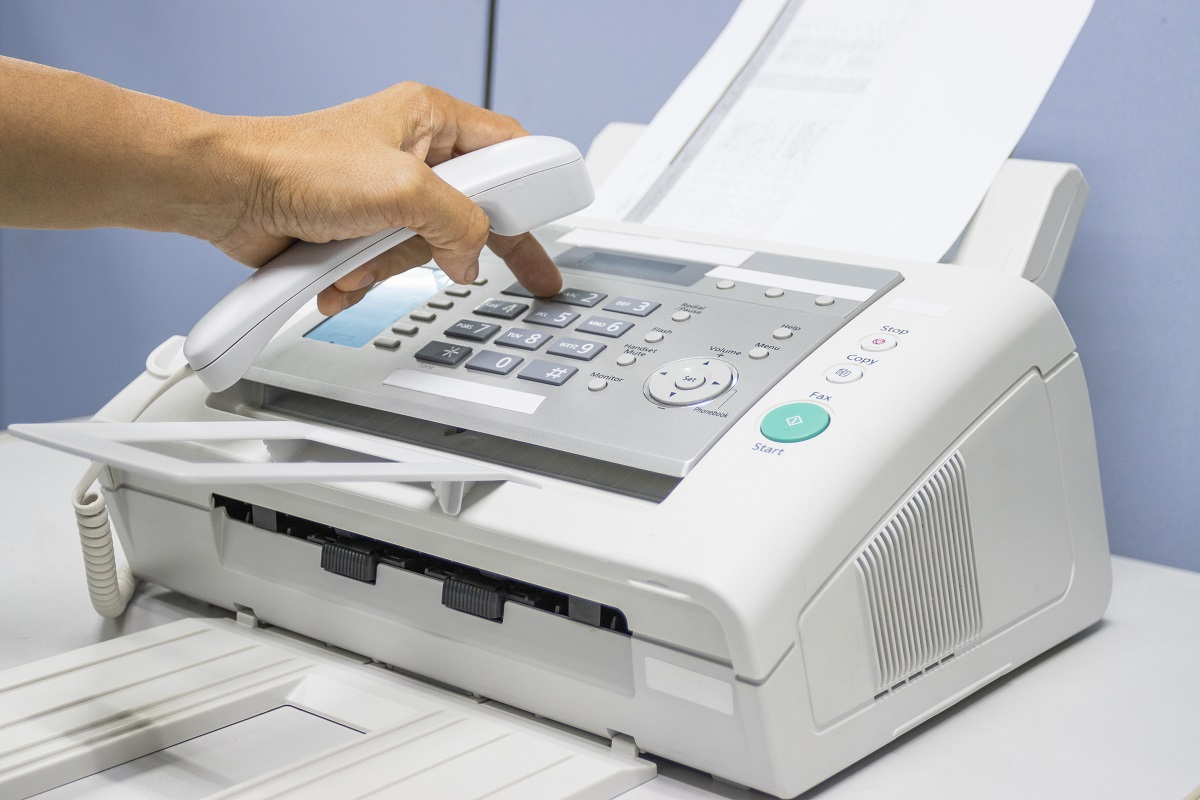
Fax, short for facsimile, is a method of sending and receiving printed documents over a phone line. It involves scanning the physical document, converting it into a digital signal, and transmitting it over telephone lines to the recipient’s fax machine. The recipient’s fax machine then converts the digital signal back into a printed document.
Fax was once the primary method of transmitting documents in the business world, but it has been largely replaced by email and other digital communication methods. However, many businesses still use fax as a way to transmit sensitive documents or when a physical copy of a document is required.
Today, faxing no longer requires a physical machine. Internet-based fax services allow users to send and receive faxes from computers, tablets, or smartphones while still delivering documents to traditional fax numbers.
Advantages of Email Communication
Email has become the go-to method of communication in the business world for a number of reasons. Some of the advantages of email communication include:
- Speed and convenience: Emails can be sent and received instantly, making it easy to communicate with colleagues and clients anywhere in the world.
- No special equipment required: You don’t need a fax machine or phone line. All you need is an internet connection and a computer, smartphone, or tablet.
- Cost-effective communication: Email typically requires only an internet connection, making it far cheaper than maintaining fax machines and phone lines.
- Ease of use: Most people already know how to send and receive emails, so little training is required.
- Environmentally friendly: Email eliminates the need for paper documents and reduces waste associated with traditional communication methods.
Advantages of Fax Communication
Although fax has largely been replaced by email and other digital communication means, it still has its advantages. Some of the benefits of fax communication include:
- Security: Fax transmissions travel over telephone networks, making them more difficult to intercept than many email transmissions.
- Legal validity: Many jurisdictions recognize faxed documents as legally binding, particularly for contracts and agreements.
- Signature verification: Fax allows signed documents to be transmitted clearly and reliably.
- Transmission reliability: Fax transmissions are typically delivered immediately and often generate confirmation receipts showing successful delivery.
Disadvantages of Email vs. Fax Communication
While both communication methods have clear strengths, they also come with limitations. The table below highlights some of the key disadvantages of email and fax.
| Category | Email Disadvantages | Fax Disadvantages |
|---|---|---|
| Spam & Noise | Inboxes can be flooded with spam and marketing messages, making it harder to find important emails. | Typically avoid spam, but unsolicited “junk faxes” and fax advertising can still occur. |
| Security Risks | Can be intercepted or compromised if systems aren’t properly secured. | Can be accessed by anyone near the machine, potentially exposing sensitive documents. |
| Information Overload | Many professionals receive hundreds of emails a day, increasing the risk of important messages being overlooked. | Slower and less flexible, making it less practical for high-volume communication. |
| Cost | Inexpensive, but may require paid services like business email platforms or storage. | Often require dedicated phone lines, machines, paper, toner, and ongoing maintenance. |
| Equipment & Accessibility | Requires internet access and a device capable of sending and receiving messages. | Traditional faxing requires specialized hardware and phone lines unless using an online fax service. |
| Functionality | Attachments may be blocked, filtered, or incompatible depending on recipient’s system. | Can’t transmit multimedia, hyperlinks, or interactive content. |
| Environmental Impact | Servers consume energy and digital storage resources. | Rely on paper, ink, and toner, which increases physical waste. |
Fax vs. Email: Comparison of Features
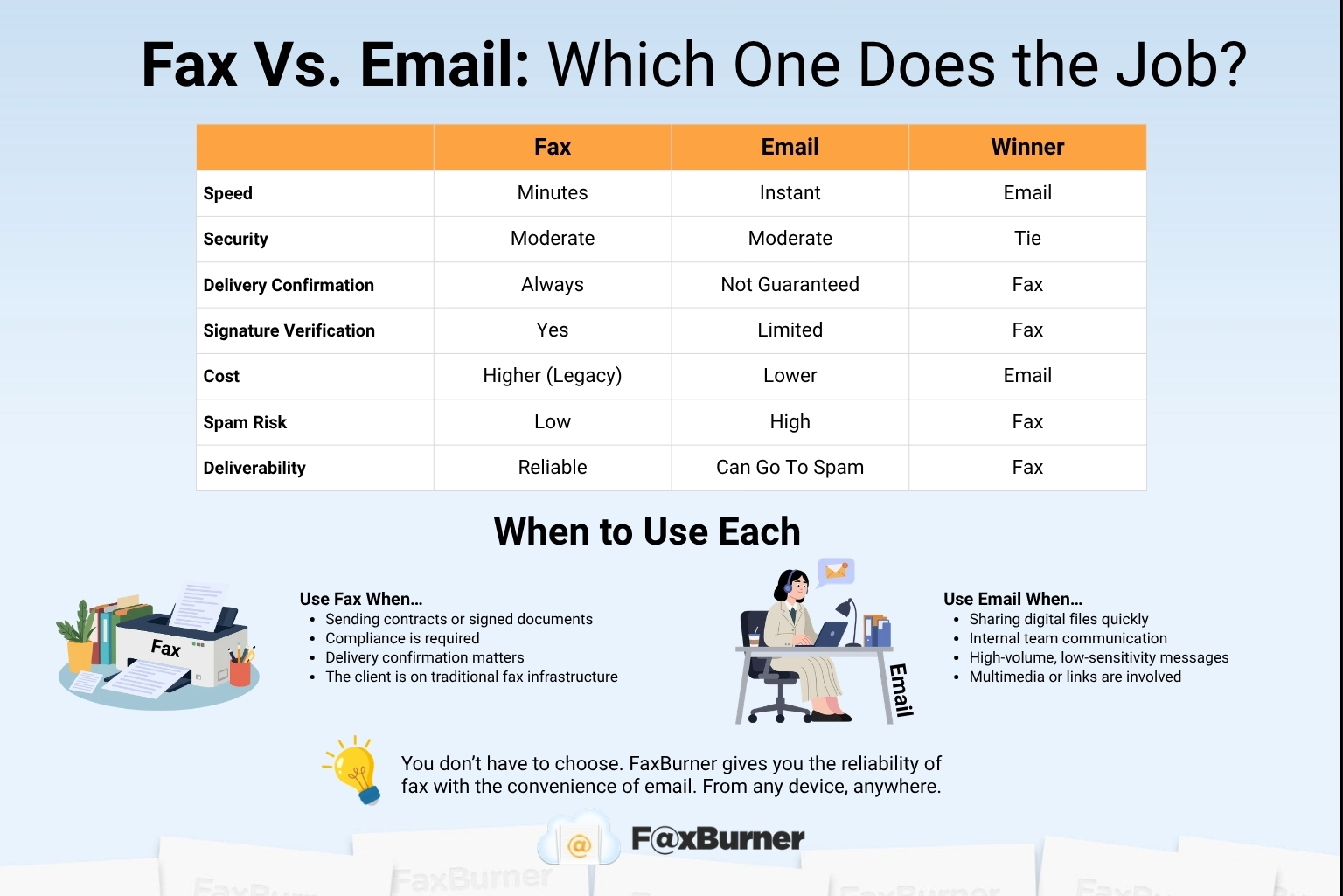
Here is a comparison of the key features of email and fax:
Document Type
Email is best suited for transmitting digital documents such as Word files, PDFs, and images. Fax, on the other hand, is best suited for transmitting printed documents.
Transmission Speed
Email is generally faster than fax, with messages being delivered instantly. Fax transmissions, on the other hand, can take several minutes to complete.
Signature Verification
Fax allows for the verification of signatures, making it a preferred method for transmitting signed documents such as contracts and agreements.
Security
Fax is generally considered more secure than email, as fax transmissions are more difficult to intercept.
Cost
Email is a cost-effective method of communication, as it only requires an internet connection and a device to send and receive messages. Fax, on the other hand, can be expensive, requiring a dedicated phone line and fax machine.
Deliverability
Another thing to highlight in this article is deliverability/visibility. Emails can be sent to spam folders or are often missed and deleted due to inboxes being inundated with other emails. Faxes, on the other hand, enjoy better deliverability and visibility as they are delivered and printed via a machine.
Security and Privacy: Email vs Fax
Security and privacy are important considerations when choosing a communication method for your business. Here is a comparison of the security and privacy features of email and fax:
Email Security and Privacy
Email is not as secure as fax, as messages can be intercepted. Generally speaking, email should not be your preferred method of sending important documents to your clients and other entities. However, there are steps you can take to improve the security of your email communications, such as using encryption and two-factor authentication.
Fax Security and Privacy
Fax is considered more secure than email, as fax transmissions are more difficult to intercept or hack. Still, traditional faxing is not entirely free from security issues. Fax machines can be vulnerable to hacking and interception, so it is important to take steps to protect your fax communications.
It is crucial to control who has access to the fax machine to avoid sensitive information getting intercepted by an unauthorized person. Collecting fax confirmation after sending documents is vital to ensure your fax went through and the recipient received your documents.
Which Is Better: Email or Fax?
The answer to this question depends on your business needs and the type of communication you need to transmit. Email is best suited for transmitting digital documents quickly and efficiently, while the fax is best for transmitting printed documents or documents that require a signature.
If security is a top priority, fax may be the preferred method of communication, as it is generally considered more secure than email. However, if cost and convenience are more important, email may be the better choice.
Choosing the Right Communication Method for Your Business
In conclusion, both email and fax have cons and pros, and the final choice between them often comes down to your specific needs. Email is best suited for transmitting digital documents quickly and efficiently, while fax offers better means for transmitting documents that require a signature.
What’s important to remember is that you don’t have to worry about accessing fax machines in order to benefit from all the advantages of faxing. Now, with online fax, you can transmit all your documents via your phone or tablet.
With FaxBurner, you can obtain your dedicated fax number and send and store all your information via our mobile app. Learn about what we can do for you today.
