

Summary
The fax machine is nearly 200 years old, but its story is anything but simple. It started with a Scottish clockmaker in 1843, passed through the hands of physicists, journalists, and military engineers, and peaked in the late 1980s when over four million fax machines were operating across the United States alone. The physical machine has since given way to apps and online services, but the underlying technology never actually went anywhere. It just got a lot easier to use.
| Time to Read | ~8 minutes |
|---|---|
| What You’ll Learn |
|
| Next Steps |
|
Before the 1840s, getting a contract or a sketch to someone miles away meant hiring a courier or trusting the postal service. A letter could take weeks, sometimes months, depending on distance and weather. Short telegraph messages helped, but they only carried words, not drawings or handwritten signatures.
Inventors set out to solve that delay. They wanted a way to reproduce entire documents at the other end of a wire, intact and legible, faster than any coach or steamship. Their experiments gave us the first fax machines, turning long waits into near-instant transfers.
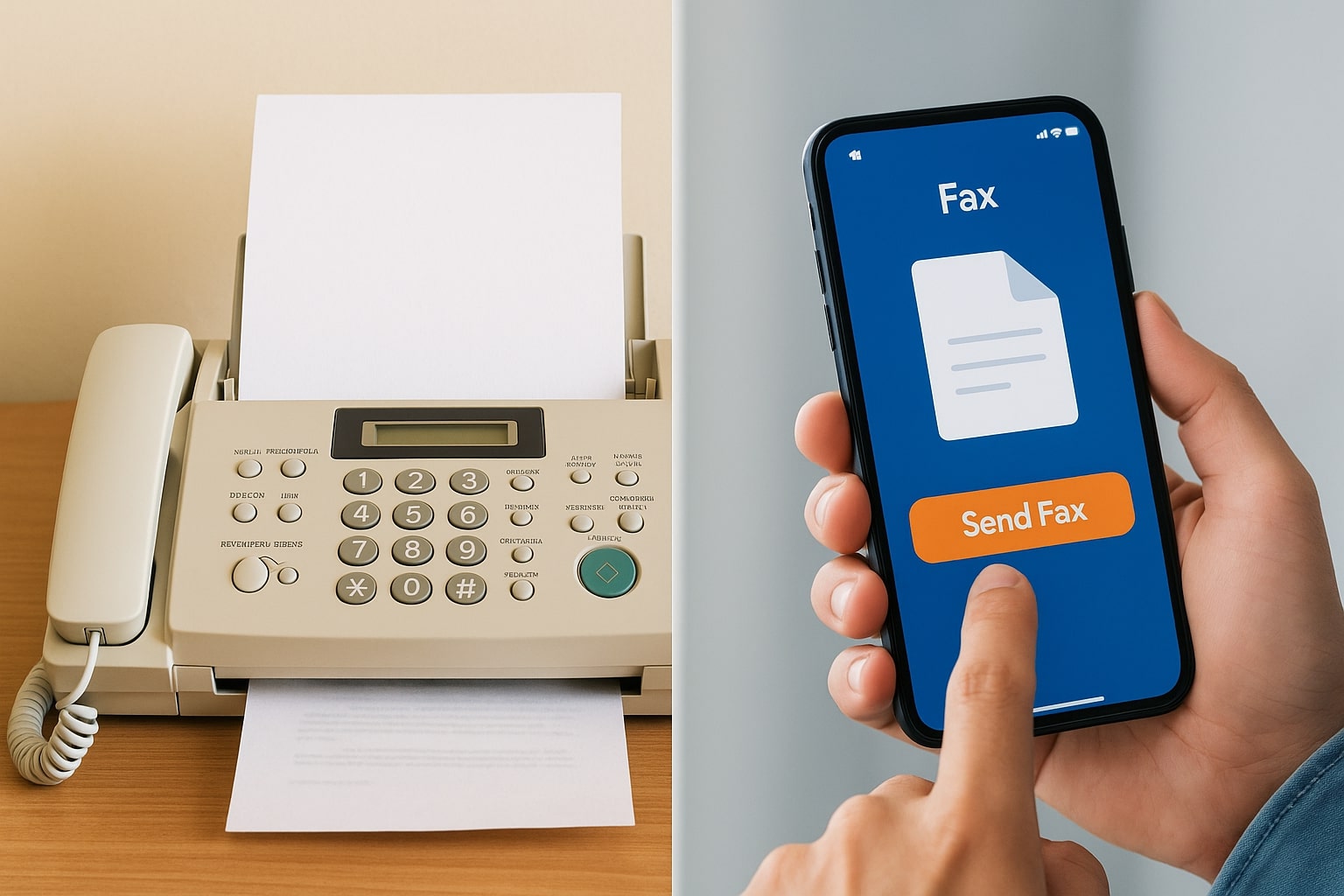
Today, the same idea lives on in your pocket. Modern fax apps, such as FaxBurner, let you scan, send, and receive faxes from a smartphone, tablet, or computer in under half a minute.
That leap from telegraph wires strung across continents to cloud-based mobile apps shows how far we’ve come since the first crude facsimile devices clicked into action nearly two centuries ago.
Who Invented the Fax Machine and When?
The first version of the fax machine was created by Scottish inventor Alexander Bain in 1843. He called it the Electric Printing Telegraph, and it was groundbreaking for its time.
Bain’s device sent images line by line using pendulums, electric currents, and chemical-soaked paper. It worked by scanning a message at one end and reproducing it at the other end using synchronized clock-like mechanisms.
That synchronization allowed both ends to stay in step, making it possible to transmit writing or images over a wire, which was unheard of back then.
Why it didn’t take off: The pendulums drifted, the prints looked faint, and every page crawled out of the machine. Businesses stayed with messengers until later inventors solved those flaws.
Key Milestones in Fax Evolution
1848 — Frederick Bakewell: Image Telegraph
A few years after Bain, English physicist Frederick Bakewell improved the idea with his Image Telegraph. He showcased it at the Great Exhibition in London, giving the public an early look at facsimile transmission. His version used synchronized cylinders to scan and receive images, but it was still too clunky for real-world use.
1865 — Giovanni Caselli: Pantelegraph
Italian physicist Giovanni Caselli created the first commercial fax system, called the Pantelegraph. It was even used by the French government to send signed documents between cities. His electrochemical transmission process improved accuracy and gave the technology its first real use case in communication.
Caselli, with help from French inventor Leon Foucault, established a long-distance fax transmission between Paris and Lyon, later extended to Marseille in 1867. This is why 1865 is considered the birth of the commercial fax machine.
1880 — Shelford Bidwell: Scanning Phototelegraph
Bidwell made it possible to scan two-dimensional originals without manual plotting or drawing, a significant step forward in making facsimile transmission practical.
1888 — Elisha Gray: Telautograph
American inventor Elisha Gray introduced the Telautograph, which could transmit handwriting in real time. Unlike previous machines, this one wasn’t about scanning whole pages; it captured pen movement and recreated it remotely. It was a major step toward modern messaging and set the stage for fax-like technology in business and personal communication.
1902 — Arthur Korn: Photoelectric Transmission
German physicist Arthur Korn developed a method for sending photographs using light-sensitive cells and rotating drums. His invention was the first to use photoelectric principles, and it changed the game.
For the first time, faxes weren’t just scanned text; they included images. This became huge for journalism and law enforcement, allowing quick transmission of mugshots, fingerprints, and other visuals.
20th Century Breakthroughs
1924 — RCA Sends First Photo Across the Atlantic
In 1924, RCA (Radio Corporation of America) sent the first photo by radio waves across the Atlantic Ocean. This marked the start of international faxing, and it grabbed the attention of the journalism world.
Newspapers began using radio fax systems to transmit photos between countries, making it faster to publish overseas news. It didn’t replace messengers yet, but it paved the way for global communication without physical transport.
That same year, AT&T transmitted the first color fax over wire transmission. Both breakthroughs in 1924 demonstrated that faxing was no longer just a curiosity but a genuine international communication tool.
1960 — US Army Faxes Photo to Puerto Rico
The US Army transmitted its first photograph via fax to Puerto Rico, demonstrating the military and governmental reach that fax technology had achieved by mid-century.
1964 — Xerox LDX: Birth of the Modern Fax Machine
Everything changed in 1964 when Xerox introduced the LDX (Long Distance Xerography) system. It was the first fax machine that could send standard-sized documents over telephone lines, making it practical for offices.
For the first time, businesses could quickly send contracts, invoices, and memos without relying on couriers. The Xerox LDX was bulky and expensive, but it proved that faxing could be fast, reliable, and scalable, and that’s when the modern era of faxing really began.
1985 — Hank Magnuski: First Computer-Based Fax
In 1985, before the internet was in full swing, Hank Magnuski, founder of GammaLink, created the first computer-based fax board. This allowed computers to join the network of fax machines, which still dwarfed the internet at that time.
The impact was dramatic: the number of US fax machines rose from 300,000 to over 4 million by 1989. In a matter of five years, fax systems had become the most important way of transmitting documents across American businesses.
How Fax Changed the World
Once fax machines became reliable and affordable, they reshaped how entire industries moved documents. In the 1980s and 1990s, analog faxing became the go-to method for sending files fast.
Offices no longer had to rely on postal mail or couriers for signed contracts, medical records, news images, or financial documents. Just feed the page, press a number, and it was gone in seconds.
Industries that relied heavily on faxing included:
✅ Journalism: Used fax to send headlines and photos across borders
✅ Finance: Relied on it for urgent transactions and approvals
✅ Legal: Sent time-sensitive case documents and contracts to courts and clients
✅ Healthcare: Shared patient referrals, prescriptions, and insurance forms instantly
By turning paper into real-time communication, faxing shortened decision cycles and helped businesses run faster. It wasn’t just a useful gadget; it became an essential part of daily operations in nearly every office.
The Digital Shift: Internet and Mobile Faxing
As the internet became part of daily life, faxing evolved again, this time ditching bulky hardware and landlines for digital tools that fit into a pocket.
1990s — Internet Fax (FoIP)
The late 1990s saw the introduction of Fax over IP (FoIP), which enabled faxes to be sent over the internet instead of traditional phone lines. This shift gave rise to email-to-fax systems and web-based fax platforms, making it easier to send and receive documents without needing a physical machine. Businesses could now fax from a computer and manage documents entirely online.
2010s — Mobile Faxing Emerges
With smartphones in nearly every hand, mobile faxing apps took over. Platforms like FaxBurner made it easy to send, receive, scan, and store faxes on the go. Users could upload documents from the cloud, take photos of paper documents, or sign files digitally, all within the app.
Related Reading:
How Does a Fax Machine Actually Work?
Here’s how the transmission process works step by step:
- A device scans a document one horizontal line at a time, looking for shades of dark and light.
- Each line is represented by a binary code of 0s and 1s, with white corresponding to 0 and black to 1.
- Once scanning is complete, each pixel is assigned a binary value and sent as a bit of data at a time.
- The receiving machine decodes these bits, printing the document or displaying it on screen.
It all happens extremely fast. In the late 1960s, it took over six minutes to send a single page. Today, online fax services can deliver multiple files in seconds.
Will Fax Machines Become Obsolete?
Fax machines may look like relics next to smartphones, but the technology itself is far from dead. The machines are declining, but the capability is not. It’s just evolving. Here’s why faxing persists:
- Industry standards are hard to change: Finance, legal, and healthcare institutions built their document workflows around fax. Getting every facility to switch to a new standard simultaneously is not realistic.
- Delivery confirmation: Unlike email, fax provides immediate confirmation that a document has arrived. That accountability matters for time-sensitive or legally significant documents.
- Legal recognition: Many courts and municipalities still require faxed signatures and documents. Some government agencies, including elements of the federal government, only accept requests by fax.
- Point-to-point transmission: Fax documents travel directly between the sender and recipient over phone lines, making them harder to intercept or alter in transit than email messages.
- Infrastructure reach: In areas with unreliable internet but stable telephone networks, fax remains the more dependable option.
What is becoming obsolete is the physical fax machine. The answer to that shift is online faxing, which preserves all of fax’s practical advantages while removing the hardware, the phone line, the paper, and the toner.
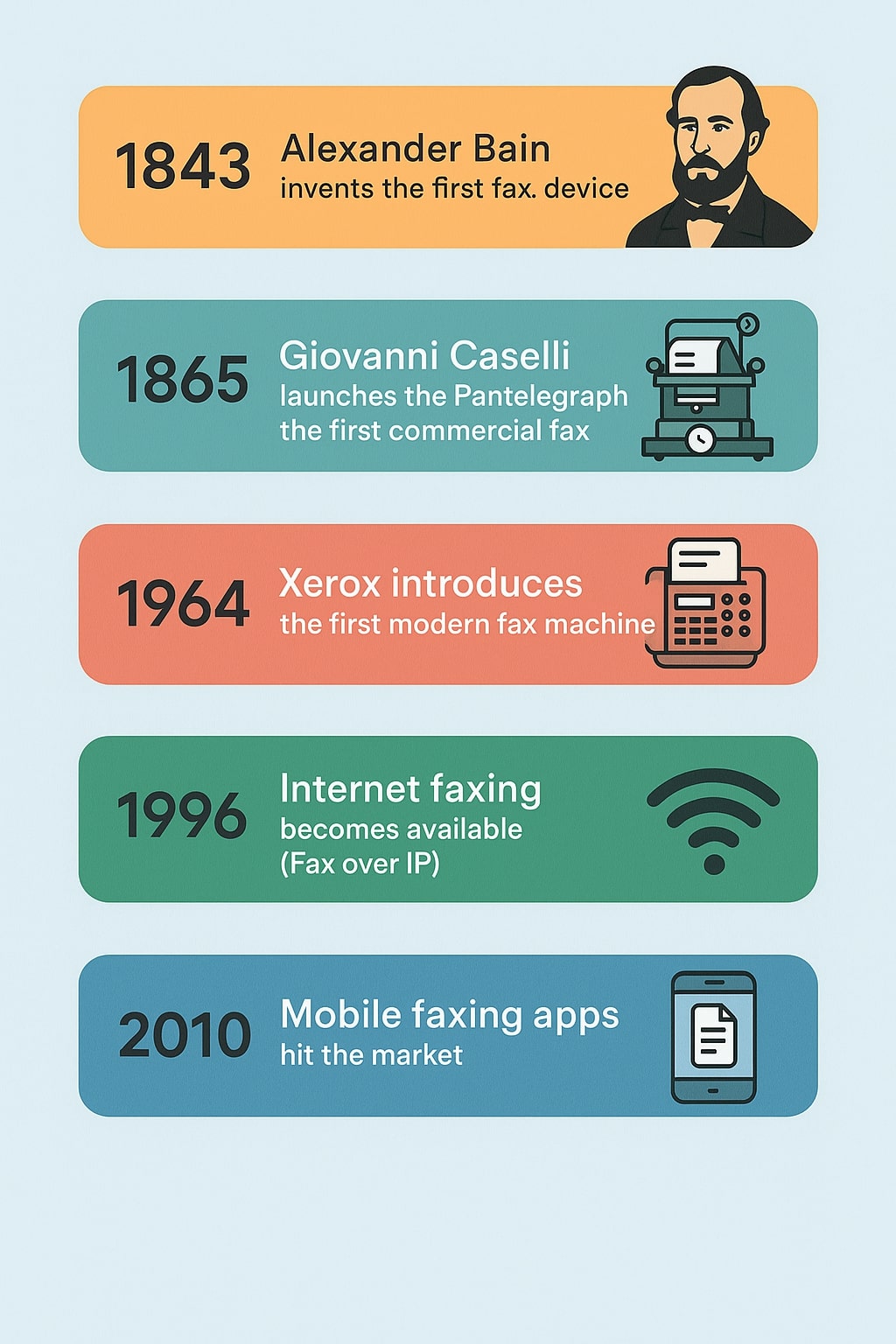
Timeline Summary: The Fax Journey at a Glance
A quick look at the key milestones that shaped how we fax today:
Conclusion: From Bain to the Cloud
Faxing has been around for more than 180 years. It began with Alexander Bain’s electric drawing machine in the 1840s and grew into tools that governments, newsrooms, and businesses came to depend on.
By the 1980s and 1990s, fax machines were in almost every office, moving contracts, records, and photos faster than mail ever could.
The purpose has always been the same: to send documents quickly and reliably. What’s changed is the way we do it. Instead of waiting by a humming machine, faxing now happens through the devices we already use every day.
FaxBurner represents that shift. It takes a technology with a long history and makes it fit into modern work. With the app, you can send, receive, and manage faxes from anywhere, all in a way that feels natural and simple. Try it today for free and see the difference for yourself.
FAQs About the Invention of the Fax Machine
When was the fax machine invented?
The first version of the fax machine was invented in 1843 by Alexander Bain. It used electric currents and pendulums to scan and transmit writing.
What was the first document ever faxed?
The exact first document isn’t recorded, but early machines sent handwritten notes and simple images line by line, not full pages like today.
When did faxing become popular?
Faxing took off in the 1980s and 1990s when analog fax machines became affordable and easy to use in offices and homes.
Is faxing still used today?
Yes. Many industries still rely on faxing, but now it’s done digitally through apps and online platforms like FaxBurner, with no machine required.
Will fax machines become obsolete?
The physical fax machine is declining, but faxing as a capability is not. Legal, healthcare, and government institutions continue to consistently use. Online fax services preserve all the advantages of traditional faxing without any of the hardware.
