

| Time to Read | ~6 minutes |
|---|---|
| What You’ll Learn |
|
| Next Steps |
|
Despite the advent of the digital age with numerous modes of communication, faxing remains a trusty companion, particularly in business communication. Comprehensive knowledge of the underlying functionality of faxing, such as creating a fax header, is vital for conveying your documents properly.
A fax header is one of the most important parts of any fax you send. Located at the very top of every page, it contains information that helps the recipient identify who sent the message, confirm they’re the intended recipient, and understand what the document contains, without having to decode the source number of the fax machine that sent it.
Craving a seamless faxing experience? At FaxBurner, we offer a top-notch free fax app for iPhone and a user-friendly free email-to-fax service for computers and phones. Our online faxing service seamlessly blends digital convenience with the practicality of faxing, ensuring every message makes its mark.
What is the Purpose of a Fax Header?
The purpose of a fax header is to provide essential data about the document you’re sending. This information is necessary for verification and helps ensure the fax is sent to the right person.
In a nutshell, fax headers are important to include in your communications because they inform recipients about the nature of your message and its urgency, and provide basic information that helps them quickly identify and organize the documents. It enables businesses and company branches to efficiently exchange vital information without resorting to unnecessary back-and-forth calls and emails to identify the source of a particular message.
While fax headers aren’t required by law, they’re a common practice that demonstrates your professionalism and attention to detail. If someone receives a fax without one and isn’t expecting anything, there’s a reasonable chance it ends up in the bin.
Essential Elements of a Fax Header
At the very least, a properly formatted fax header should contain the sender’s name, the date, and the dispatching fax number. A complete, professional header includes more than that.
| Element | Required? | Why It Matters |
|---|---|---|
| Sender’s name | Yes | Identifies who sent the fax and prevents it from being discarded as spam |
| Sender’s company | Recommended | Should be included when faxing outside your organization |
| Sender’s fax number | Yes | Allows the recipient to reply or flag a misdirected fax |
| Sender’s phone number | Recommended | Provides a direct contact for follow-up |
| Recipient’s name | Yes | Confirms the fax is reaching the right person |
| Recipient’s fax number | Yes | Catches misdirected faxes before they cause a problem |
| Date and time | Yes | Critical for time-sensitive documents and cross-timezone comms |
| Page count | Yes | Lets the recipient confirm all pages were received |
| Brief description | Yes | Helps the recipient prioritize and file the document |
A Note on the Sender’s Name
Many people wonder whether to put their own name or their company’s name in the fax header. The answer depends on context. If you’re faxing someone you know personally, your name alone is fine. If the fax is going to another company or an unfamiliar recipient, include both your name and your company’s name. When in doubt, include both. It’s more professional and removes any ambiguity.
A Note on the Date
The sending date is absolutely necessary, especially if the documents contain action items that need to be completed in a timely manner. If you’re faxing across different time zones, the date becomes even more important; a recipient in a six-hour time difference may not see your fax until the next business day, making it harder to gauge urgency without a clear timestamp.
Fax Header Example
To help you better understand fax headers, we’ve put together an example.
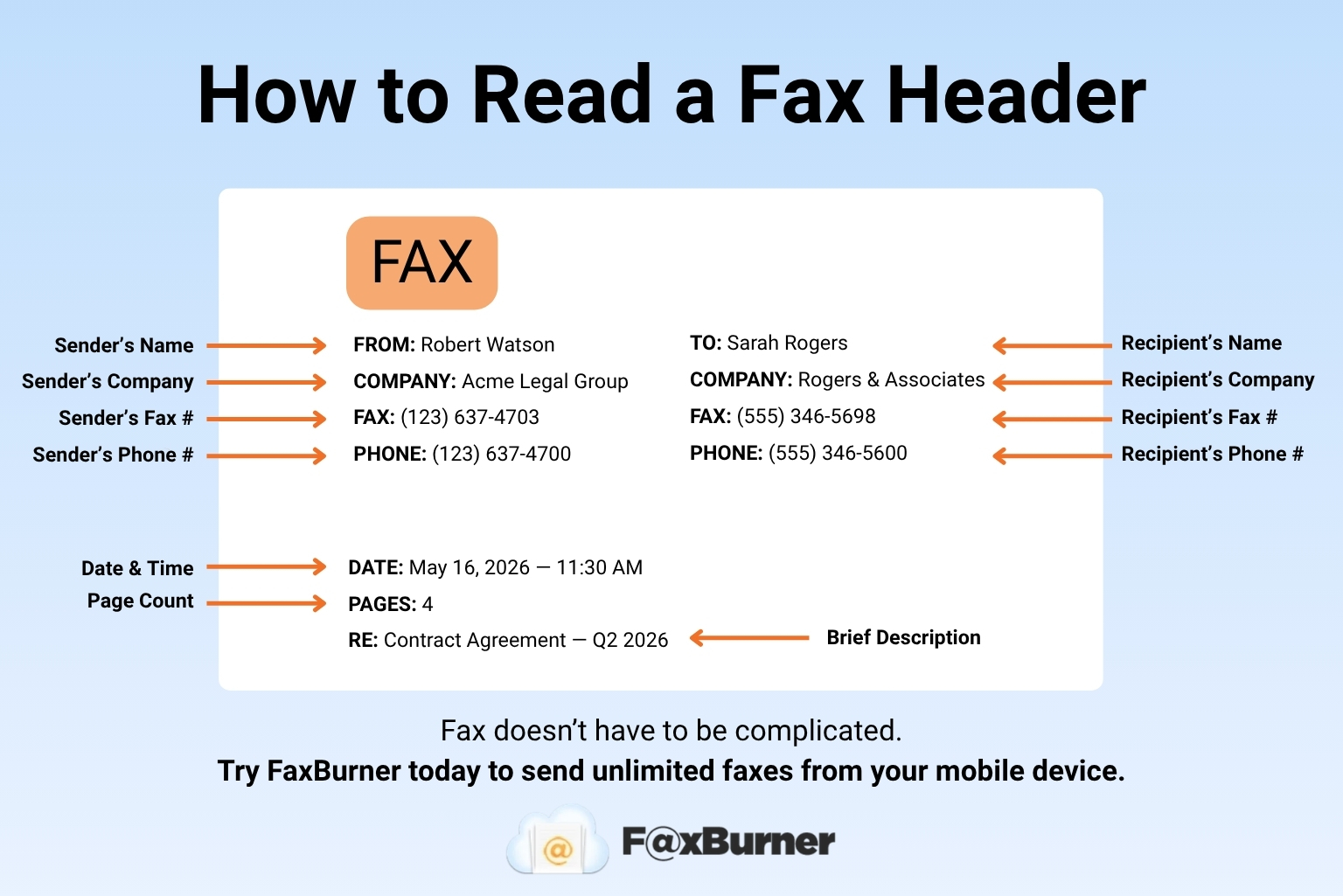
In this example, Robert Watson is sending a four-page contract agreement to Sarah Rogers on the morning of May 16th. The recipient can immediately confirm it was meant for them, identify the sender and their company, check whether all four pages arrived, and understand the nature of the document before reading a single word.
The brief description, “Contract Agreement”, is arguably the most useful line. It tells the recipient how to prioritize the fax relative to everything else in their inbox, and it provides a clear label for filing.
How to Set up a Fax Header in Your Machine
Setting up an automatic fax header means it will appear on every page of every fax you send from that machine without you having to add it manually each time. Here’s how:
- Turn on your fax machine and confirm it’s connected to an active phone line.
- Open the fax settings menu. The process varies by make and model, so refer to your user manual if needed.
- Find the fax header option. It may be labeled “Fax Header,” “Header Information,” or similar.
- Enter your name and company, fax number, and phone number in the appropriate fields.
- Enter the recipient’s details. Double-check the fax number for accuracy before saving.
- Add a brief description of the document in the designated field.
- Save and exit the settings menu. The header will now appear automatically on all outgoing faxes.
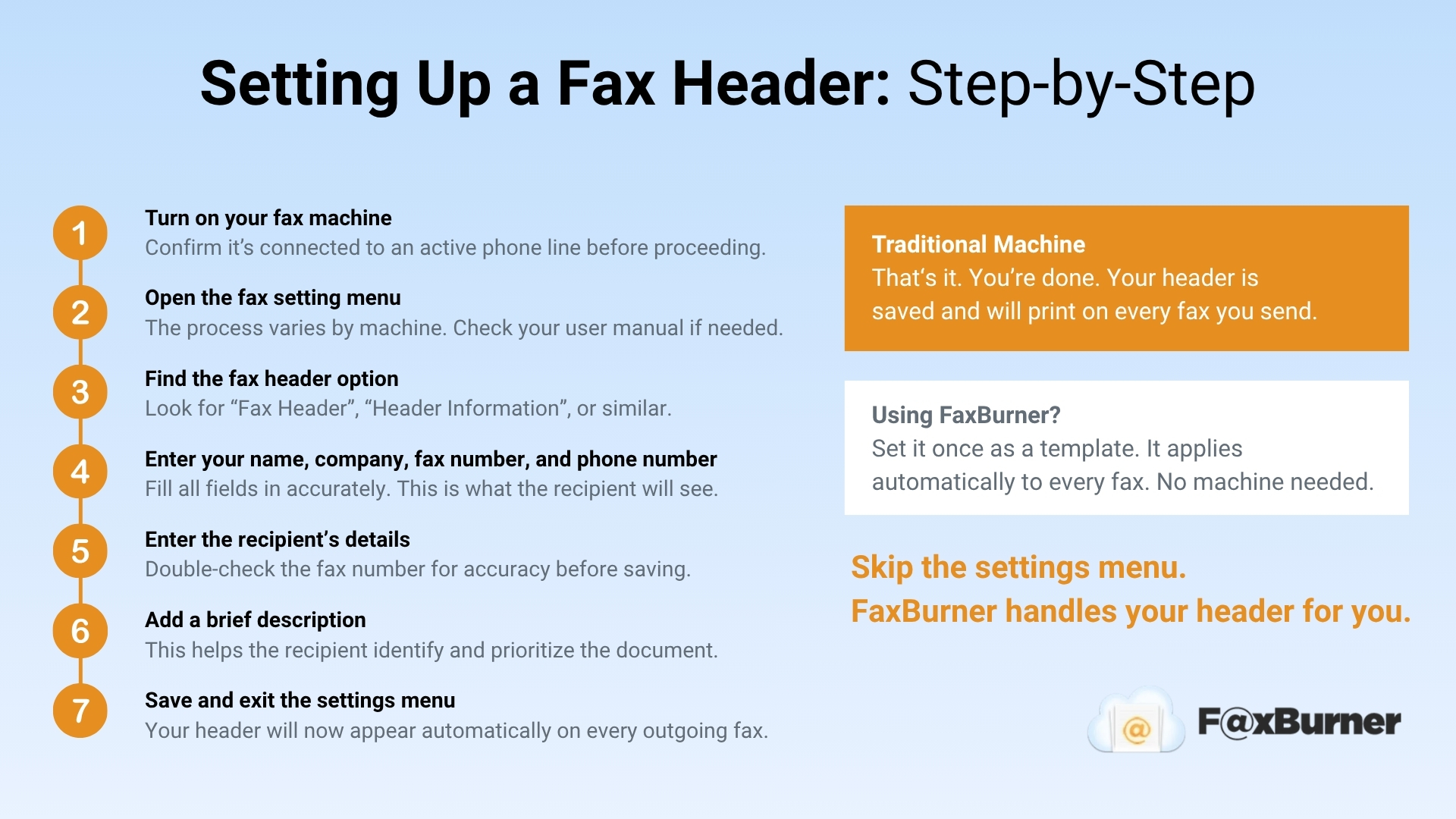
If you use an online faxing service like FaxBurner, the header can be created as a template and applied automatically to every fax you send, without the need for manual configuration required each time.
How Is a Fax Header Different From a Fax Cover Sheet?
Fax headers and fax cover sheets serve different purposes and should not be confused with one another.
The fax header is mandatory and appears at the top of every page of the fax. It contains the essential identification information: sender and recipient names, fax numbers, phone numbers, date and time, page count, and a brief description. Its purpose is to ensure the document is delivered to the intended recipient with all necessary details visible on every page.
The fax cover sheet, on the other hand, is optional and appears only on the first page. It includes similar contact information but also allows for additional messages, instructions, or a confidentiality disclaimer. It provides context and makes it easier for the recipient to handle the fax. Most professional faxes should include both.
The Bottom Line
A fax header is an important feature of any document you send, and you should always remember to include it. It contains crucial information about the sender, the recipient, and the contents of the fax, and it’s one of the simplest ways to ensure your communications are handled correctly on the other end.
Using an online faxing service like FaxBurner makes this even easier, as the header can be automatically generated from your account information, so you don’t have to remember to add it yourself. Sign up for one of our plans and find out how straightforward it can be in the FaxBurner app.
